It depends on who's building it. But the honest answer is: probably longer than you think.
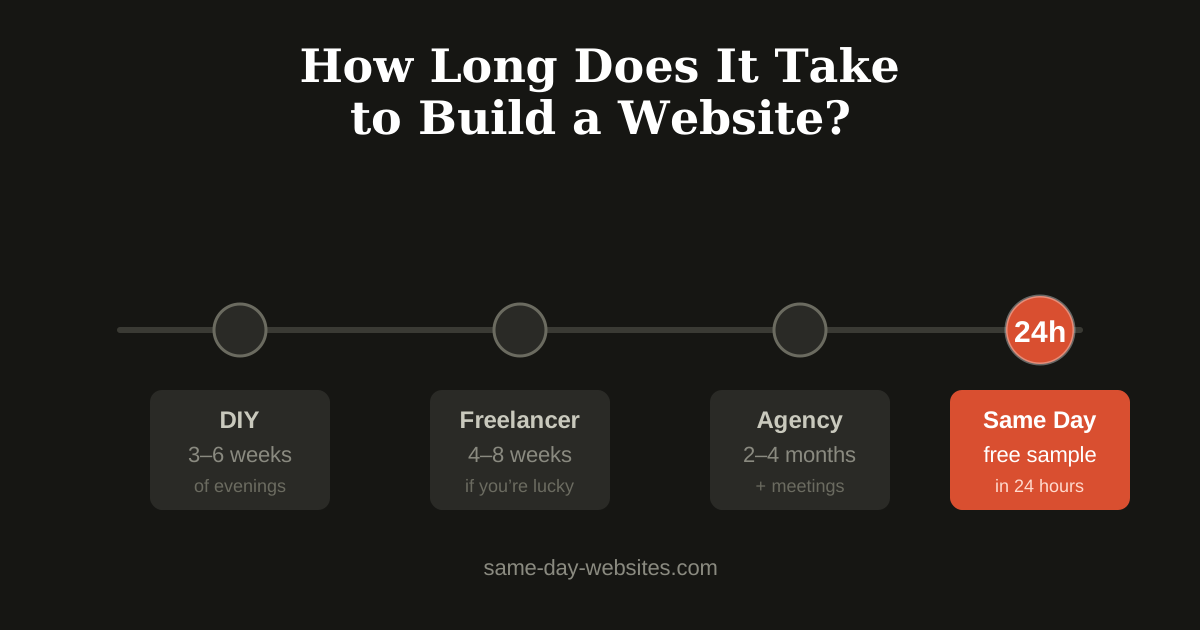
Ask three people how long a website takes and you'll get three answers. The DIY crowd says a weekend. A freelancer says six weeks. An agency says "it depends" and sends a proposal with a Gantt chart.
Here's what it actually takes in 2026 — DIY, freelancer, and agency — and why the fastest option isn't the corner-cutting one.
How long does it take to build a website yourself?
Plan on 20 to 40 hours of your own time, spread across three to six weeks of evenings and weekends.
The page builders make the first hour feel magical. Pick a template, swap in your logo, done-ish. Then reality shows up: writing the actual words for five pages, finding photos that don't look like stock, making the mobile version not look broken, connecting the contact form to an email you actually check, figuring out why Google won't show your site.
None of that is hard. It's just slow when it's your fifth job of the day. Most DIY websites stall at 80% done — finished enough to stop working on, not finished enough to send customers to. The site isn't the slow part. Your calendar is.
How long does a freelancer take to build a website?
Four to eight weeks is typical — and that's after they start. Good freelancers are usually booked two to four weeks out before your project even begins.
Here's where the weeks go. Week one: kickoff call, plus homework for you — send the logo, the photos, the copy. Weeks two to three: first draft. Then revision rounds, and every round of "can we try the blue one" adds three to five days while your project sits in their queue behind other clients. Then the content delay: they can't finish until you send final wording and photos, and you're busy running your business.
The uncomfortable truth about freelancers: the good ones are slow because they're in demand, and the available ones are available because nobody rebooks them. Either way, you're looking at a month or two from "let's do this" to "it's live."
How long does a web design agency take?
Two to four months. Sometimes more.
Agencies run a process: discovery workshops, sitemaps, wireframes, design concepts, revision rounds, development sprints, QA testing, launch checklists. Every phase has meetings, sign-offs, and handoffs. For a 50-page corporate site with three stakeholders, that process earns its keep. For a contractor who needs five pages and a phone number people can tap, it's a cannon aimed at a fly.
You're not really buying a website from an agency. You're buying their process, their project manager, and their overhead — and the calendar reflects it.
What actually eats up all that time?
Here's the secret: building a small business website takes days. The calendar gets eaten by everything around the building.
- Content. Writing the words, gathering photos, deciding what goes on each page. This is the number-one delay on almost every project, and it sits with the business owner, not the builder.
- Revision round-trips. Every "one more tweak" cycle costs three to five days of queue time — not the twenty minutes the tweak itself takes.
- Meetings. Status calls about the status of the thing. Discovery sessions. Alignment syncs. Each one burns a day on either side of it.
- The queue. You're one of a dozen clients. Your project moves when your slot comes up, not when the work needs doing.
Strip those four things away and a competent builder can design and hand-code a clean five-page site in a matter of days. The work was never the bottleneck. The process was.
How long should a small business website take?
Days. Not weeks, not months — days.
A focused build looks like this: day one is structure and content — what goes on each page and the words to fill it. Day two is design and build — the actual pages, built for phones first because that's where your customers are. Day three is polish and launch — testing, speed, going live.
That's not rushing. Rushing is skipping the thinking. This is doing the thinking up front, then building without the ceremony. A five-page site for a plumber or an electrician doesn't need a discovery workshop. It needs someone who has built dozens of them and knows exactly what goes where.
So when someone quotes you eight weeks for a brochure site, ask what happens in those eight weeks. If the answer is mostly process, you're paying for the process.
What's the fastest legitimate way to get a website?
See it before you commit to anything.
The slowest part of every website project is the leap of faith — paying thousands up front and hoping the result is worth it six weeks later. Flip that around: get a free working sample of your homepage built first, in 24 hours. You look at the real thing, on your phone, with your business name on it. Then you decide.
No deposit-and-pray. No "trust the process" for two months. You see the quality on day one, and the full site follows in days, not weeks. Custom sites from $299 — here's exactly what that covers.
The bottom line
A website takes as long as the work requires. For most small businesses, the work requires days — everything beyond that is process, queue time, or someone learning on your dime.
Ask any builder for a timeline, then ask what fills it. The honest ones will tell you. And if the timeline is measured in months for a site measured in pages, keep shopping.
At Same Day Websites, we build custom websites for contractors and small businesses. Free working sample of your homepage in 24 hours — you approve it before you spend a dollar. Sites from $299. Because the only thing slower than not having a website is waiting three months for one.
Ready to get your business online?
We build custom websites for small businesses in 24 hours. No templates, no page builders — just clean, professional sites that make you look as good as you actually are.
See your free sample site →