Most people decide whether to trust your business in about five seconds.
They land on your website, glance around, and either stick or bounce. That's the whole window.
If your site can't answer a few basic questions in that time, the visitor leaves and calls the next guy. Doesn't matter how good your work is. They never got far enough to find out.
I call this the five-second trust test. Here's what your contractor website has to prove before the clock runs out.
What is the five-second trust test?
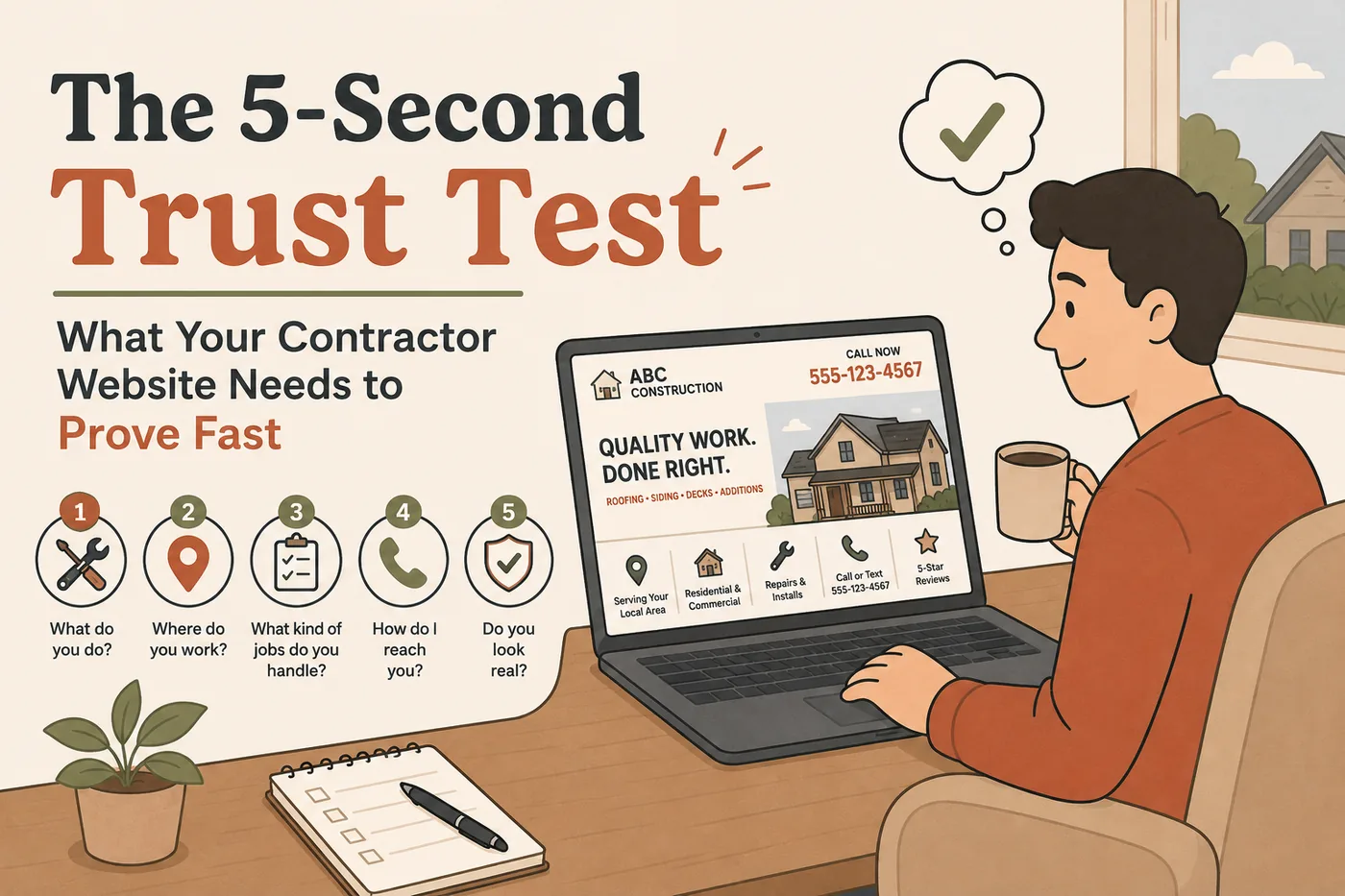
The five-second trust test is the quick gut check a visitor runs the moment your website loads. In those first few seconds, they're trying to answer five questions:
- What do you do? The service has to be obvious.
- Where do you work? Your service area should be easy to spot.
- What kind of jobs do you handle? Small repairs, big installs, or both.
- How do I reach you? A phone number, no digging required.
- Do you look real? Photos, reviews, and a site that doesn't look abandoned.
Pass all five and you've earned a phone call. Miss even one and you're already fighting uphill.
Let's break each one down.
What do you do?
This sounds dumb, but a shocking number of contractor websites bury the actual service. Somebody clicks through and sees a slogan about "quality craftsmanship since 2008" and a stock photo of a sunset. Cool. But are you a roofer or a plumber?
Tell people what you do in plain words, up top, where they can't miss it. "Licensed electrician serving Fairfield County." That's it. They should know what they're looking at before they scroll.
If a stranger can't name your trade in two seconds, you've already failed the first question.
Where do you work?
Nobody wants to read your whole story, click the contact page, and then find out you don't even cover their town. That's a wasted click and an annoyed visitor.
Put your service area where people can see it fast. The town, the county, the region, whatever fits. "Serving Southbury, Newtown, and the surrounding towns" does more work than three paragraphs of company history.
This also happens to be how people search. They type "plumber near me" or "roofer in Danbury." When your site says the place out loud, Google notices and so does the customer.
What kind of jobs do you handle?
A homeowner with a leaky faucet and a developer building a strip mall are both looking for help, but they're not looking for the same person. Your site should signal which jobs are yours.
You don't need a novel. A short list does it. Residential and commercial. Repairs and new installs. Emergency calls. Whatever's true for you. The point is to let the right people self-select and stop wasting time on the wrong ones.
When somebody sees their exact problem listed on your page, they relax. They think, "Okay, this guy does what I need." That feeling is half the sale.
How do I reach you?
Here's the one that drives me nuts. A contractor does everything right, and then hides the phone number three pages deep behind a contact form nobody fills out.
Your number should be visible the second the page loads. Top of the screen, tappable on a phone, no scrolling. Somebody standing in a flooded basement is not going to hunt for it. They'll call whoever makes it easy.
Make calling you the easiest thing on the page. That's the whole job of a contractor website.
Do you look real?
This is the quiet one, and it might be the most important. People can smell a fake or a dead site from a mile away. A page with no photos, no reviews, and a copyright date from four years ago tells visitors you might not even be in business anymore.
A few things prove you're legit:
- Real photos of real work. Your jobs, your trucks, your crew. Not stock images.
- A handful of reviews. Even three or four honest ones beat zero.
- A site that looks maintained. Clean, current, loads fast on a phone.
You don't need anything fancy. You need it to look like a real person stands behind it. Because one does.
Why five seconds matters more than ever
People scroll fast and judge faster. They've got three tabs open and your competitor in two of them. Attention is short and patience is shorter.
The good news is that passing the test is simple. It isn't about flashy design or a giant budget. It's about answering five obvious questions before the visitor gets bored and leaves.
Most contractor websites fail because they were built to look impressive instead of built to be useful. Flip that. Make it useful first. The trust comes right behind it.
How to know if your site passes
Try this. Pull up your own website on your phone and count to five. In that time, can a total stranger tell what you do, where you work, what jobs you take, and how to call you? And does the whole thing look like a real business?
If yes, you're in good shape. If you're not sure, that's your answer.
Most sites I look at fail at least one of the five, and usually it's the phone number or the photos. The fixes are quick. The cost of leaving them broken is every customer who bounced before they ever heard from you.
Frequently asked questions
How long do I have to make a first impression on my website?
About five seconds. Visitors decide almost instantly whether to stay or leave, so your most important information has to load fast and sit up top.
What's the most important thing on a contractor website?
A visible phone number. People hiring a contractor usually want to call, not fill out a form. Make the number tappable and easy to find on a phone.
Do I really need photos on my website?
Yes. Real photos of your work are one of the fastest ways to prove you're a real, active business. They build trust faster than anything you can write.
My business does fine on word of mouth. Why do I need a website?
Even referrals check you out online before they call. A weak or missing website can talk a warm lead out of hiring you before you ever pick up the phone.
Want to see if your business passes the five-second trust test? Request a free sample site at same-day-websites.com/contact. I'll build it, you take a look, and you decide from there.
Ready to get your business online?
We build custom websites for small businesses in 24 hours. No templates, no page builders — just clean, professional sites that make you look as good as you actually are.
See your free sample site →