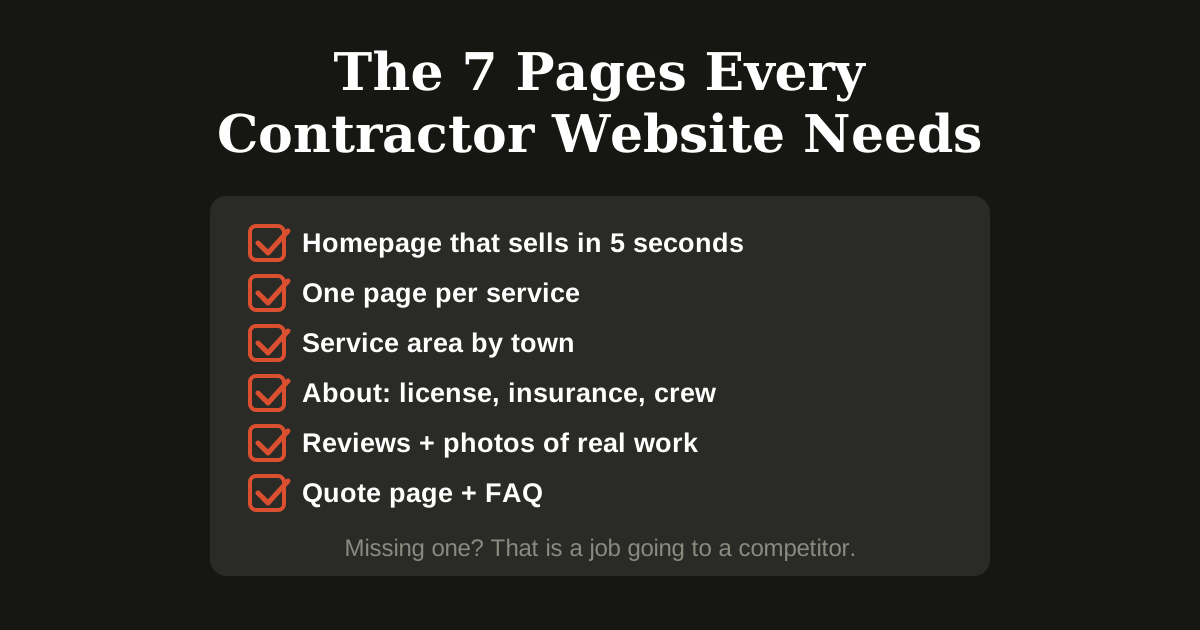
Most contractor websites fail for a boring reason: they are missing pages. Not fancy features, not a redesign — just the pages a customer actually needs before they will pick up the phone. If your site is a homepage and a contact form, you are asking visitors to trust you with almost nothing to go on.
A contractor website does not need twenty pages. It needs the right seven. Each one answers a question your customer is already asking. Here is the list, in the order that matters.
1. A homepage that answers three questions in five seconds
Your homepage has one job: convince a stranger, fast, that you are the right call. Most visitors decide in about five seconds, and they are looking for three things: what you do, where you do it, and how to reach you. If any of those takes scrolling to find, you have already lost people.
Put your trade and your service area in the headline itself — "Emergency Plumber in Seymour, CT," not "Welcome to Our Website." Put a tap-to-call phone number at the very top, on every page, not just the contact page. And put one clear next step above the fold: "Get a Free Quote" beats "Learn More" every time, because it tells the visitor exactly what happens next.
2. One services page per service — not one page for everything
This is the most common mistake on contractor websites: a single "Services" page that lists drain cleaning, water heaters, sewer repair, and bathroom remodels in one paragraph each. That page helps nobody, and it hurts your Google rankings, because Google cannot tell what the page is actually about.
Give each major service its own page. A plumber needs separate pages for drain cleaning, water heater replacement, and emergency plumbing. Each page should say what the job involves, when a customer needs it, what it typically costs or what affects the price, and how fast you can get there. That is also how customers search — nobody Googles "plumber services," they Google "water heater replacement near me" — and a dedicated page is what shows up.
3. A service area page that names the towns you actually serve
Customers search by town. "Electrician in Oxford CT" and "electrician in Seymour CT" are two different searches, and a generic "Serving the Greater Area" line matches neither of them. A service area page that lists the towns you genuinely cover — and says whether you charge a trip fee outside them — does two jobs at once: it helps you show up in local searches, and it stops you getting calls from towns you will never drive to.
Be honest on this page — listing towns you do not serve brings leads you will turn down.
4. An about page that proves you are a real, licensed business
Nobody hires a contractor from a website that could belong to anyone. Your about page is where trust gets built: your license number, your insurance, how long you have been in business, and photos of your actual crew and trucks — not stock photos of smiling strangers in hard hats. Customers can tell the difference, and stock photos actively hurt trust.
A short founder story helps too, but keep it about the customer, not yourself. "We started this company because homeowners kept getting ghosted by contractors" is a story. "We are passionate about excellence" is a slogan, and nobody believes slogans.
5. A reviews and past work page
Reviews are the closest thing to a referral your website can offer. A dedicated reviews page — pulling in your real Google reviews, not typed-out quotes with no source — lets a cautious customer do what they were going to do anyway: check whether other people trust you. Link it to your Google profile so they can verify the reviews are real.
Pair it with photos of finished jobs, with a line about each one: what the problem was, what you did, and what it cost to fix, where you can share that. Before-and-after photos do more persuading than any paragraph about quality ever will.
6. A contact and quote page that makes it easy to say yes
Your contact page should not be a form with twelve fields and a prayer. Every field you add costs you submissions. Name, phone number, what they need, and an optional photo upload — that is enough to call them back with a useful answer. If someone is standing in a flooded basement, they are not filling out your twelve-field form. They are calling the next plumber.
Also say what happens after they submit: "We call back within one business hour, 7am to 7pm." The fastest responder wins most contractor jobs.
7. A frequently asked questions page
Your FAQ page is secretly an SEO page. Customers ask Google the exact questions your customers ask you: "How much does a panel upgrade cost?" "Do you offer emergency service on weekends?" "Are you licensed and insured?" Each question gets its own short, honest answer — and each answer is a chance to show up when someone searches that question.
Write down the ten questions you answer on the phone every week. That is your FAQ page, and it will save you phone time too, because customers who have already read the answer call ready to book instead of ready to interrogate.
Pages you can skip — for now
You do not need a blog on day one, a careers page, a press page, or a page for every keyword you can think of. A thin site with seven strong pages beats a bloated site with thirty empty ones, because every weak page dilutes the strong ones in Google's eyes and confuses the visitor. Add a blog later, once the core seven are solid — that is where ongoing content earns its keep.
The quick audit
Open your website right now and check it against this list. Can a visitor find what you do, where you do it, and how to call you within five seconds? Does each service have its own page? Are your towns, license, reviews, and real job photos on the site? Is the quote form short, and does it promise a callback time you actually keep?
Every "no" is a job you are quietly losing to the competitor whose site answers it. None of these pages are hard to build — they are just specific.
The bottom line
A contractor website is not a brochure. It is a salesperson that works while you are on a job site. Give it the seven pages a customer needs — a clear homepage, a page per service, your service area, proof you are legitimate, real reviews and photos, an easy quote page, and honest FAQs — and it starts earning its keep.
At Same Day Websites, we build custom websites for contractors and small businesses, with every one of these pages included. Free working sample of your homepage in 24 hours — you approve it before you spend a dollar. Sites from $299.
Ready to get your business online?
We build custom websites for small businesses in 24 hours. No templates, no page builders — just clean, professional sites that make you look as good as you actually are.
See your free sample site →